
16 September 2026
Amruta Kshemkalyani explores lighting as critical infrastructure at Lighting Innovation Summit
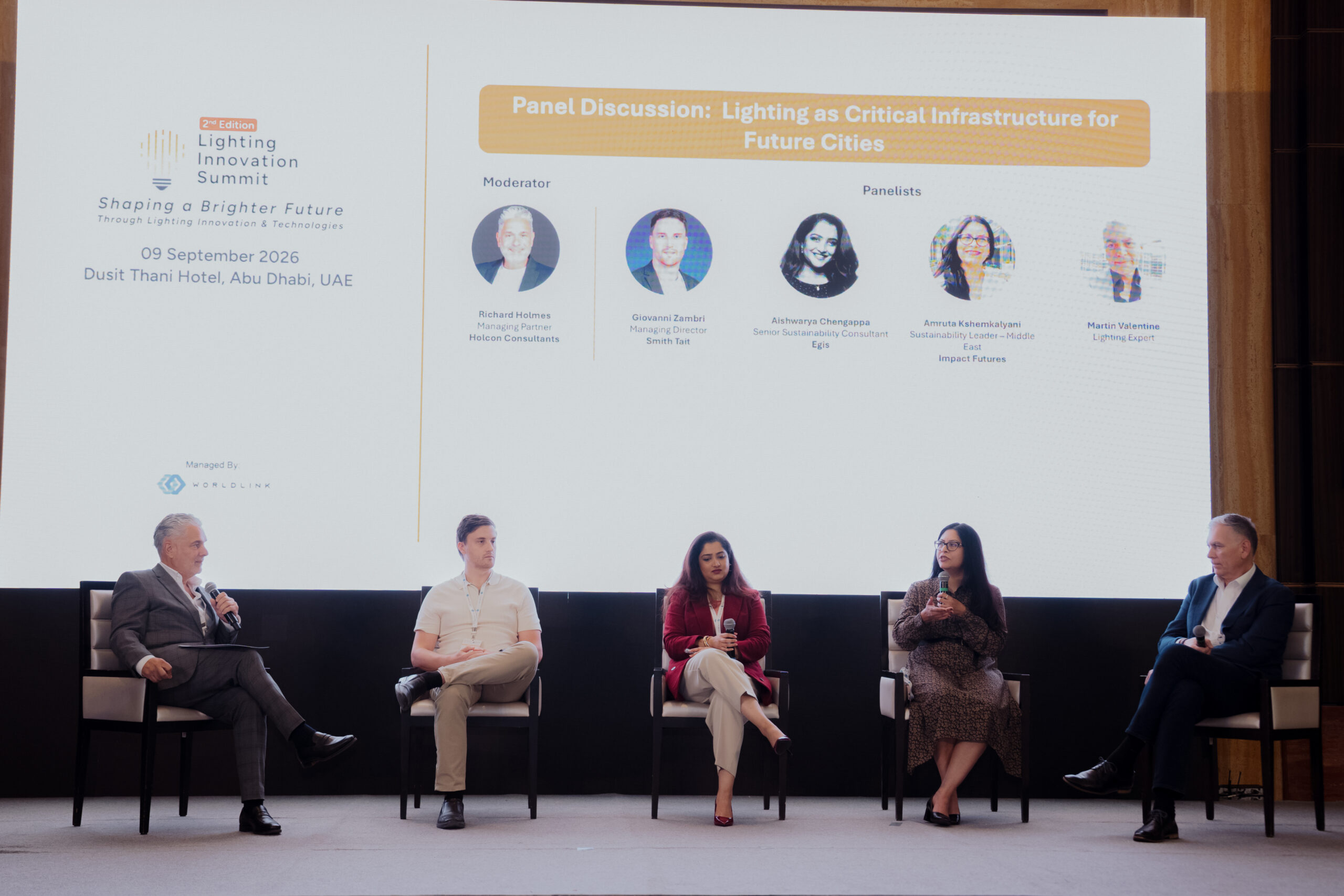
At the recent Lighting Innovation Summit in Abu Dhabi, Impact Futures Sustainability Leader for Middle East, Amruta Kshemkalyani joined industry leaders on a panel discussion titled “Lighting as Critical Infrastructure for Future Cities”, encouraging attendees to think differently about the role lighting plays in shaping urban life.
Cities have long relied on lighting to support life after dark. Advances in technology have improved efficiency and expanded the possibilities for smart systems. However, as Amruta observed, the conversation often remains focussed on performance in place of impact.
“Lighting should not just make cities brighter. It should make them healthier and more comfortable for the people who use them.”
That perspective shaped Amruta’s contribution to the panel discussion. While lighting remains essential for safety and navigation, its influence extends much further. The way cities are lit affects how people experience places, particularly during the hours when much of urban life now takes place.
Modern cities are increasingly illuminated by public lighting, digital displays and advertising screens. These systems serve an important purpose, but they can also create unintended consequences. Excessive brightness and glare can disrupt circadian rhythm and sleep patterns.
Drawing on her own experience, Amruta reflected on a residential community in Dubai where a brightly illuminated advertising screen at a nearby school began affecting the sleep of surrounding residents. Community members raised concerns and worked with local management to resolve the issue.
The example highlights a broader challenge. Not every part of a city should be lit in the same way. Lighting needs to be designed in zones, where residential areas or protected areas need to be treated differently than in CBDs. Adjacent to nature reserves or protected habitats, it can also interfere with species that depend on darkness as part of their natural ecosystem and may result in biodiversity loss.
Amruta believes lighting should respond to the character and function of a place. Adaptive systems offer one way to achieve that balance, providing illumination when needed rather than treating brightness as a constant condition.
Many of these decisions are established early, though lighting and sustainability specialists are often brought into projects after fundamental directions have already been set. By involving these disciplines during visioning and pre-concept stages, projects can better align their ambitions with the outcomes they hope to achieve.
The discussion also explored what happens when those ambitions are not carried through delivery. Lighting strategies are frequently affected during value engineering, particularly when sustainability objectives have not been clearly translated into project requirements from the outset. Stronger briefs and closer collaboration can help protect those intentions throughout the life of a project.
For Amruta, the conversation ultimately comes back to the purpose of city-making itself, noting “We are not designing cities and masterplans for our lifetime alone. We are designing them for future generations.”
The strongest outcomes emerge when projects move beyond technical measures and consider the wider experience of living in a place. That requires a more holistic way of thinking, one that recognises the relationship between people, the places they inhabit and the ecosystems that surround them.
In that context, lighting becomes more than a technical solution. It becomes part of how cities support human wellbeing and remain livable cities for future generations.